
Most days, I’m here to give you my thoughts. But I’ve sat through enough shit this year—looking at you Matchbox the Movie—to earn a brief suspension of democracy. So today, I’m giving you yours.
Sit down. Face the screen. You will not interrogate this film about what it means, dust it for the fingerprints of Martin McDonagh’s prior works, or leave the theater with a six-leg Oscar parlay to feed that gambling problem you’ve mistaken for an interest in cinema.
You will have a fucking good time.
This being an edict and not a prediction, many of you will find compliance clinically difficult.
We can discuss how right I was after the credits.
Wild Horse Nine is, front to back, the year’s most gleefully hilarious film. John Malkovich is at a peak so high above oxygenated air that much of the theater will have trouble breathing. The source of his material? Dinosaurs as a good opener for a memoir, the age at which you’re allowed to utilize the word “indigenous,” the concurrence of democracy, gayness, and cheese quality in a given society—you name it. I can only assume the riffs about the most fascist Teletubby were cut for time.
The film begins with Chris Carlisle (Malkovich) being interviewed, in 1973, by his longtime protégé Lee Chesterfield (Sam Rockwell) at their office in Chile. Quickly, we learn that Chris has been at the center of pretty much every one of the CIA’s greatest hits over the preceding two decades. He happily annotates each illustration of his work product with the level of success each attained. The Bay of Pigs? Less successful. That thing down in Dallas in ’63. Huge success.
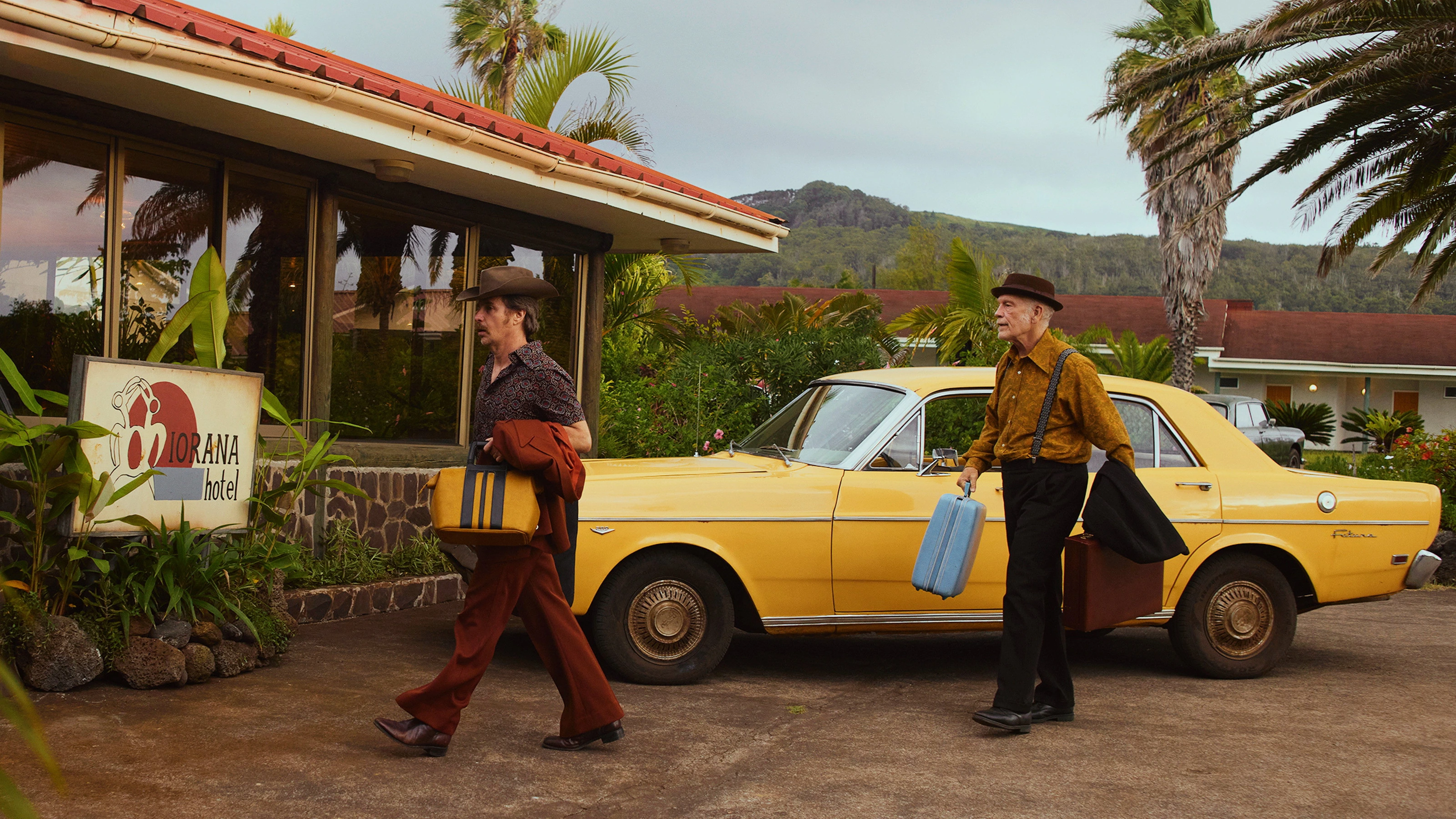
The pair soon heads to Easter Island for a little R&R, though Chris sees no reason to leave the work talk at the office. He’ll happily play the old bangers for anyone within earshot, along with a preview of what he’s still working on in the studio. At the airport, they sit across from two young women, Monica (Mariana di Girolamo) and Alicia (Ailín Salas), who are making the same trip. Chris flirts with the serene shamelessness of a man with nothing left to lose. Lee seems worried about Chris crossing the line with all this yammering until Chris reminds Lee that he can’t spell Czechoslovakia.
Overruled, as it were.
As the pair arrives at their destination, we start to get an inkling that Chris may not have the best memory in the agency. This forgetfulness adds a certain element of danger to his morphine addiction, but otherwise seems benign for the time being. Before drifting off into his drug-induced slumber, he pulls a note to himself from his pocket that reminds him he’s dying. Does he mean, like, now? A few more minutes of dialogue between the men make it clear that the note isn’t philosophical.
As Chris’s condition comes into focus, Lee starts taking calls that suggest it may not be what kills him. First up is station chief MJ (Steve Buscemi), who is much more concerned with Chris’s penchant for blabbing than Monica and Alicia seem to be. His beef isn’t just an open-ended complaint—Lee is told to do something about it if WikiLeaks on morphine comes back out for an encore. Later comes a call from Lee’s wife, Marge (Parker Posey), who immediately steals the screen, pivoting from verbally dismantling her husband to worrying about both men with the ease of someone who’s spent years doing both. She also fills us in on a little euthanasic request Chris made of Lee earlier in the month, which this trip was meant to fulfill. Does Chris remember his ask? Does MJ fucking care?
From there, the film heads toward the resolution everyone—Chris’s cancer included—seems determined to bring about. Malkovich carries himself through every moment on screen as a man floating above concern for anything beyond whatever happens to be on his mind. His impending death has provoked a renewed sense of wonder at all the things he never noticed before—are moths able to cope with rain?—and a subtle appreciation for the camaraderie his old friend offers in what everyone knows are his last days. If his reflection sometimes falls into questions of what kind of person he’s amounted to in his years, it needn’t spoil the moment—all of it comes sheathed in plenty of acerbic wit.
Rockwell grounds Malkovich’s unhindered performance in the quiet pain of the companion already beginning to miss his friend, even as he too happily falls back into their old rhythms of laughter and banter. He can’t do much about the dying, but he’ll be damned if Chris has to spend his last days learning a more sophisticated name for the “big heads.”
In the end, the pair’s break from overthrowing a democracy to give a dying man a proper send-off makes a surprisingly tender case for spending what time you have left in good company.
Enjoy yourself while you’re here. That’s an order.
← Back to reviews