
There’s nothing worse than an arsonist that doesn’t have the good manners to completely immolate his target.
It’s just easier on the bystanders.
Maybe I’m just a dick, but a smoking crater is so much less of a burden. “What a shame” to the surviving residents and on with your day. A house torched by a half-assed pyromaniac? Now you’re glum about the house and furious about the fascia. That porch could be saved. Most of that siding is fine but you’ve got to worry about whether insurance will use the fire to deny coverage if something else happens down the line. Fast forward to three in the morning and you’ve got a twenty-page to-do list stapled to the inside of your skull and no way to cross a fucking thing off.
How to Rob a Bank is a testament to what David Leitch can salvage from a script that should have been left to burn—and that inconsiderate bastard can salvage quite a lot. Mark Bianculli’s screenplay seems determined to beat you over the head until neon Mario coins spill out. The film adds that effect to the robbers’ heavily edited YouTube footage, presumably so you’ll recognize the procedure.
The movie’s core premise—vague, “fuck the man” anarchy driving people to crime—isn’t new. Giving it a YouTube channel stopped counting as a fresh spin about a decade ago. Executing it this well is just a human rights violation. But I guess we’ve got to get into it.
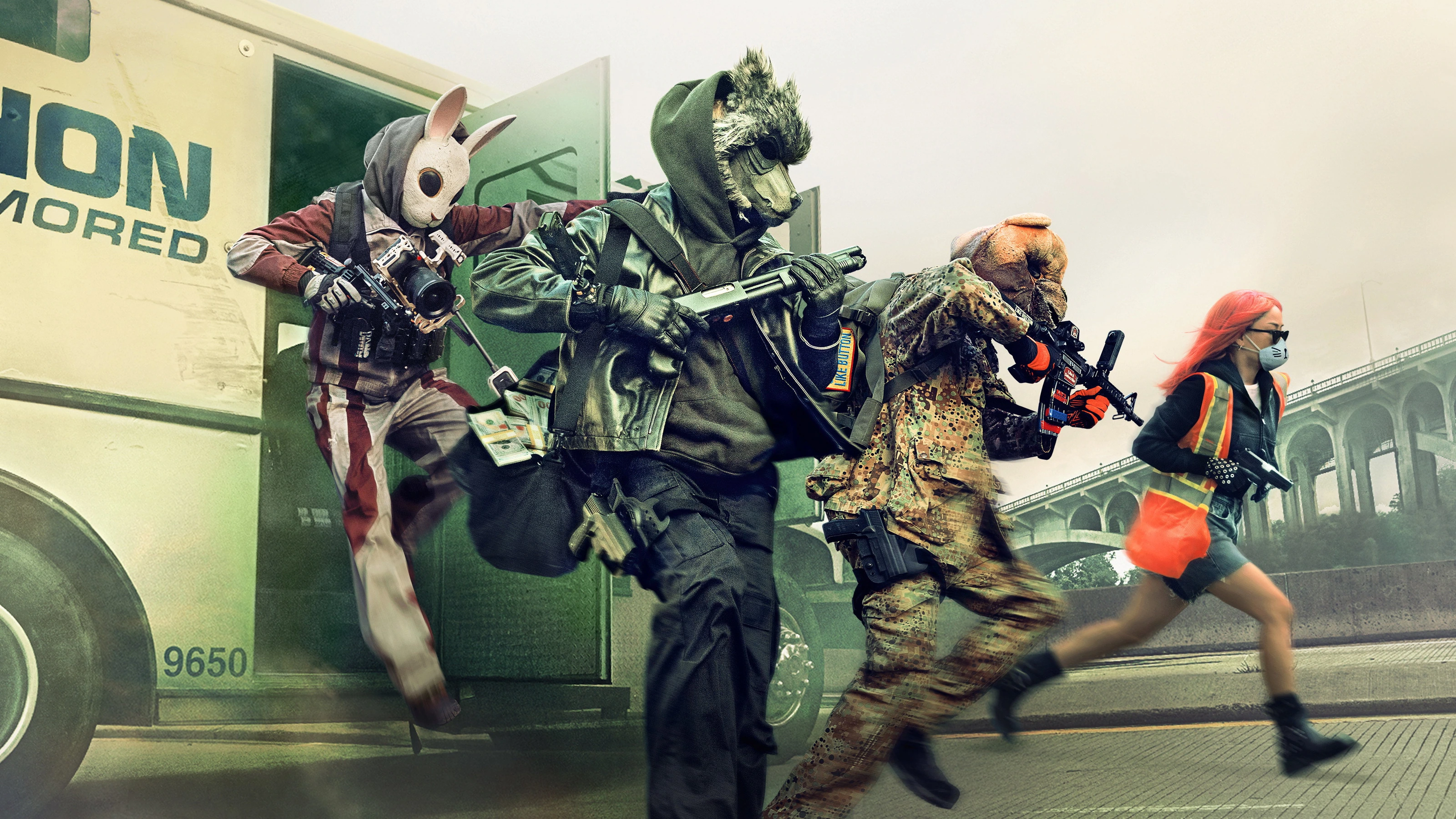
Agent John West (John C. Reilly) is leading an FBI team investigating a string of bank robberies in Pittsburgh. The real rub for the analog government men isn’t that the bandits keep getting away with it. It’s that they’re posting the evidence on YouTube and presenting it as a night school course in bank robbery.
The donut shop rewards members are out of ideas until one of the windbreaker guys half-heartedly suggests that they find a computer criminal of their own. That sends West to Reagan Gardner (Zoë Kravitz), a former hacker turned current pothead cliché whose suspiciously convenient résumé includes tracking down elusive people through their digital footprints. Her guinea pig is named Morpheus, so we know she’s cool and that Bianculli has seen at least one movie with a good script.
Painfully overqualified to play such half-baked empty shirts, Kravitz and Reilly fall into a warm buddy cop banter with too much charm for the script to make any use of. My only complaint is that, at times, Kravitz gives her work for the FBI enough emotional weight to suggest she’s wandered into a better movie. Fortunately, she’s talented enough to act her way back out.
On the more felonious side of the cops-and-robbers cast, we find a similar amount of frustration. Emi (Anna Sawai) and Ryan (Nicholas Hoult) are most compelling when the screenplay leaves their pain unexplained long enough for them to express it. Both can make you lean in, whether to find out what’s behind those wounded looks or simply to enjoy their effortless affection. Once the screenplay fills in their backstories, it insists on explaining how every goddamn feeling proves out its anarchist motivational underpinnings. Every so often, though, one of them slips a little genuine hurt past the lecture, and I’m stupid enough to get interested again.
Sucks when talent gets in the way of a good bonfire.
Pete Davidson would normally be here to save us from giving a shit. Naturally, he picks this movie to turn in what might be the best performance of his career. His Vince developed lung cancer while serving in Afghanistan, and he’s the only member of the crew whose trauma feels like it existed before somebody needed a reason to rob a bank. Unlike Emi and Ryan’s “unpayable loans,” his suffering doesn’t feel reverse-engineered from a FUCK THE MAN bumper sticker. And what he does with a character crafted by a less heavy hand could have been a film unto itself.
Christian Slater, at least, gets boned exactly as expected as the embodiment of the script’s repacked rage. Stuffed into an expensive suit and strung up as the corporate piñata, he’s there to lend a target to whatever the movie happens to be mad at. All the effort that might have gone into giving his character some dimension has instead gone into supplying additional reasons to hit him. Even the furniture in his comically ostentatious office seems designed to piss people off—guest chairs that look like the offspring of a Rubik’s Cube and a disco ball, with all of the lumbar support you’d expect from such a glitzy torture device.
Where this litany of great work done under duress leaves us—I’ll begrudgingly admit—is not such a terrible place. Its dated message does less damage than it could because the film never quite commits to it. Or, more accurately, can’t land it. The early hyper-edited visual style is broken up by enough tender, direct scenes to make it all very tolerable. And Leitch spends the whole time doing God’s work in keeping the script’s worst impulses at bay for as long as humanly possible.
As the movie enters final descent, Leitch and the cast have largely smoothed all of the rough edges the script dumped in their laps and we seem to be in the clear. Then the final moments start pitching a sequel.
If Bianculli gets the pen for that one, I hope the arsonist takes a little more pride in his work.
← Back to reviews