
I’ll admit it took me 2 sittings to get through this one. Not because I lost focus like a frat guy three White Claws into a story about why he was going to need six years to graduate. Getting up and making some notes had a purpose and the story I was abandoning might still have had a point.
Roughly an hour into Verity, you’re halfway through what could conceivably become a modern Body Double.
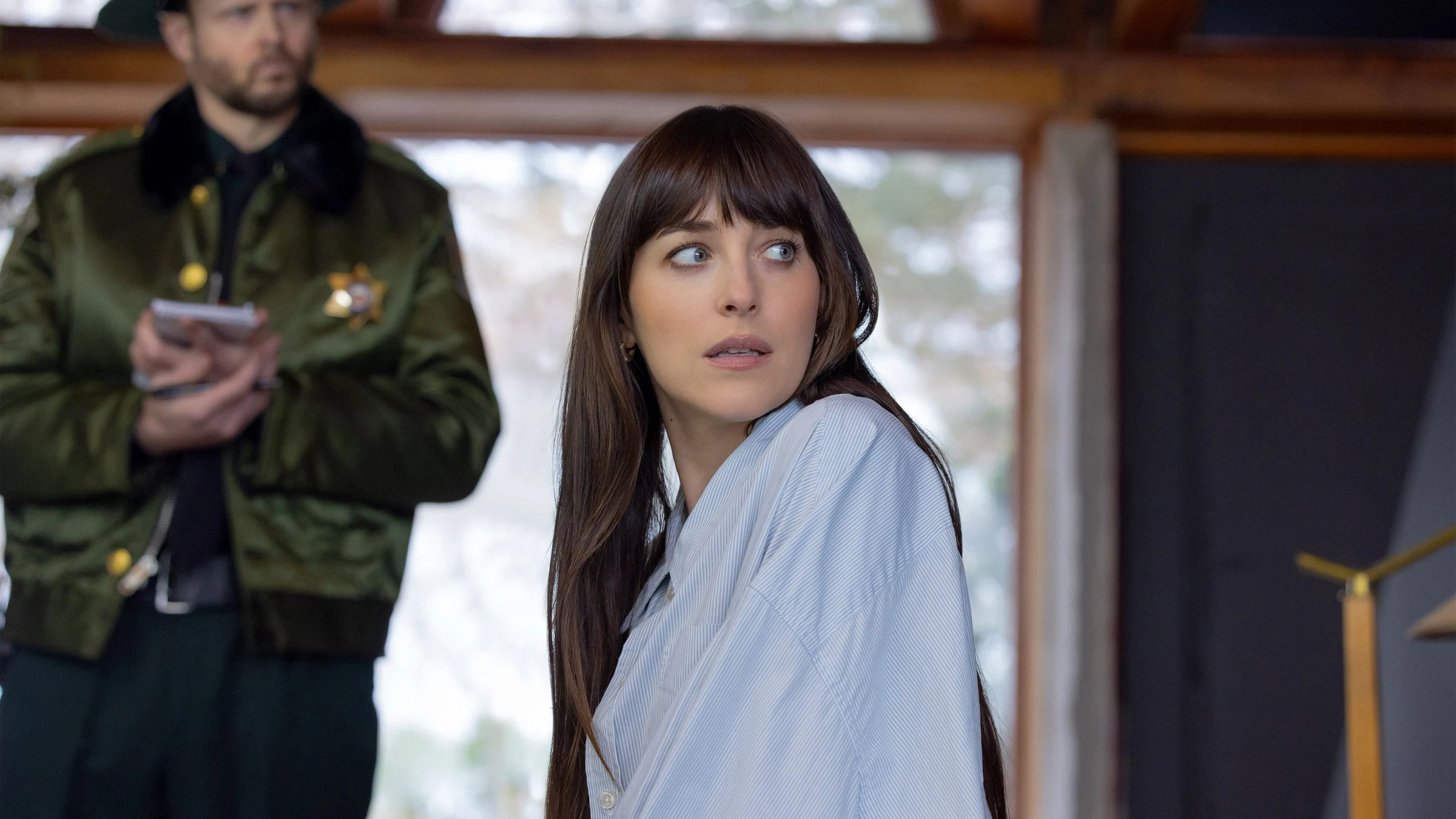
Not finding much success in her own attempts at the author grind, Lowen (Dakota Johnson) gets an offer to cosplay as a version of herself who writes books people actually want to read—and to do so from a home nobody is actively trying to evict her from. On the way to the meeting where she’s set to receive this literary Oprah treatment, a cyclist’s ride into some kind of food processor car ends as you’d expect and leaves Lowen in need of a full-service decontamination shower.
Now covered in puréed commuter—and wrapping up a monologue about how much she enjoys being a wallflower in NYC—Lowen is finally noticeable enough to catch the attention of a “random” guy (Josh Hartnett) on the street. He takes her somewhere to hose off the super-unprofessional brain matter before her meeting with the publishing conglomerate.
The ensuing bathroom cleanup has exactly the instant chemistry, required states of undress, and nimble, oblique character exposition you’d hope to get when the movie’s two top-billed actors are thrown together by fate and liquefied cyclist.
The revelation that random guy from the blood and guts carwash is also the guy she’s meeting is, honestly, far from unexpected but it doesn’t matter—the movie already has you by the lapels.
Approximately 0.4 minutes of requisite “I’m not going to take the job” play-acting later, Lowen is headed out to the home of Verity Crawford (Anne Hathaway), who is random guy Jeremy’s wife and the abovementioned author-with-actual-fanbase. Verity’s house is, naturally, half respectable family estate and half swinger’s-club Fallingwater: sexy rock-cave bathtubs and circular couches tucked among just enough normal rich-person square footage to maintain the fiction that a child is being raised and an incapacitated woman cared for somewhere inside its snow-covered perky exterior.
After getting the lay of the house, its inhabitants, and just how profoundly unable to write Verity currently is, Lowen heads down to Verity’s she-cave of literary terror. It comes complete with a couch practically begging for adultery to occur atop it and Verity’s old pack of smokes, inside of which sits a s’cute little monogrammed flash drive containing her unpublished autobiography.
And man, is that unpublished fucker exactly the dose of premium pulp the movie needs to lock itself into the “I’m not getting up to pee until this is over” category for at least another half hour.
After a lengthy disclaimer—in which Verity alternates between reading her own book on tape in some kind of sex hotline voice and appearing at her desk like the world’s sexiest bad-news correspondent—she promises that what follows will be unpleasantly truthful. And then totally calls that Lowen is going to keep reading anyway.
Finally we get to the headboard-biting meat of it.
Jeremy and Verity, it turns out, have the kind of steamy romantic origin story required of prospective buyers of a Playboy Mansion bathtub. Verity became an author mostly to occupy herself while Jeremy was away for work, presumably because this was the aughts and Amazon had not yet perfected same-day battery delivery.
Then came the children.
To Verity’s considerable displeasure, motherhood introduced competitors for Jeremy’s affection. And Verity responded to this emotional inconvenience by allowing her inner murder novelist—which was obviously also her outer, nationally acclaimed murder novelist—to workshop some solutions.
Trust me when I tell you: up to this point, the execution is legitimately enthralling.
It is pulpy as fuck. It is ridiculous. It is also so humiliatingly effective at making you need the next chapter from the murderscript that every time Lowen closes it to do something responsible—sleep, work, respect another human being’s privacy—you’re fucking pissed at her.
Then, somewhere around the hour mark, the movie begins handing out the kind of revelations I can’t describe without wandering into spoiler territory—and the batting average starts dropping fast. The twists keep coming, to be sure. They’re just increasingly greeted with less holy shit and more oh, for fuck’s sake. And the moody ambiance starts to crumble as the whiplash begins to overtake the pulp.
Once the will-they-or-won’t-they becomes oh fuck yeah they will, the weight of the setup snaps back into perspective as a lot to land quickly—thus my own sabbatical to record how it felt until then.
The problem isn’t that Verity gets ridiculous. It’s that, after spending more than half its runtime cultivating a good-or-evil investigation around one character, the movie starts trying to extend the same question to the whole fucking cast. And that’s all left for the third act.
The first hour earns that ambiguity because it lets the audience investigate Verity right alongside Lowen. She puts down the manuscript, wanders back into the house, and starts asking Jeremy seemingly innocuous questions—only to have him casually confirm some way-too-specific detail from Verity’s purported confession. Every little corroboration sends you back into the room with Lowen, increasingly desperate for her to pick the damn thing up and keep reading that fucker. By the time the third act widens the inquiry from who Verity is to who any of these people really are, the movie no longer has the runway to let those suspicions develop the same way. They arrive more as revelations than discoveries, and that’s a much less satisfying game to play.
If you’re someone who needs the whole thing to work to walk away happy, I’d find the exits around that time and salvage what works. But if you’re one of the few who understands that pulp is rarely in the business of elegant resolution, welcome to the Fuck I Can't Believe I Liked This Club.
← Back to reviews