
What the fuck is this thing?
It’s as if Mötley Crüe and Poison were onstage with Chris Farley, Mask-ed up Jim Carrey, Macho Man Randy Savage, and—fuck it—the goddamn Kool-Aid Man. The stage itself is a massively scaled-up Dance Dance Revolution platform with a million dollars in aftermarket pyrotechnics bolted to the sides in an apparently deliberate effort to violate every provision of the fire code. Appearances are still important though, so Patrick Ewing’s barber came in before the show, gave everybody a trim, and checked his work with a laser level. Please exit the show through the karaoke bar.
I only know that I’m completely terrified but entirely here for it.
And if all that sounds like I’m gratuitously throwing shit at the wall, welp you have a working understanding of Street Fighter, give or take some dick jokes. Evaluating whether this Pollock painting of electro-vomit succeeds would first require getting my head around what the hell it’s trying to do. And I’m convinced that doing so would mean missing the point altogether.
Street Fighter is roughly two hours of director Kitao Sakurai waterboarding your dopamine receptors. Lesser critics will inevitably describe the film as “maximalist” or “stylized.” Seamus Maguire declines to share a design vocabulary with anyone who mistakes a zebra-print rug in their fourth guest bedroom for a personality. Whatever we’re working with here, Wayfair does not have it in stock.
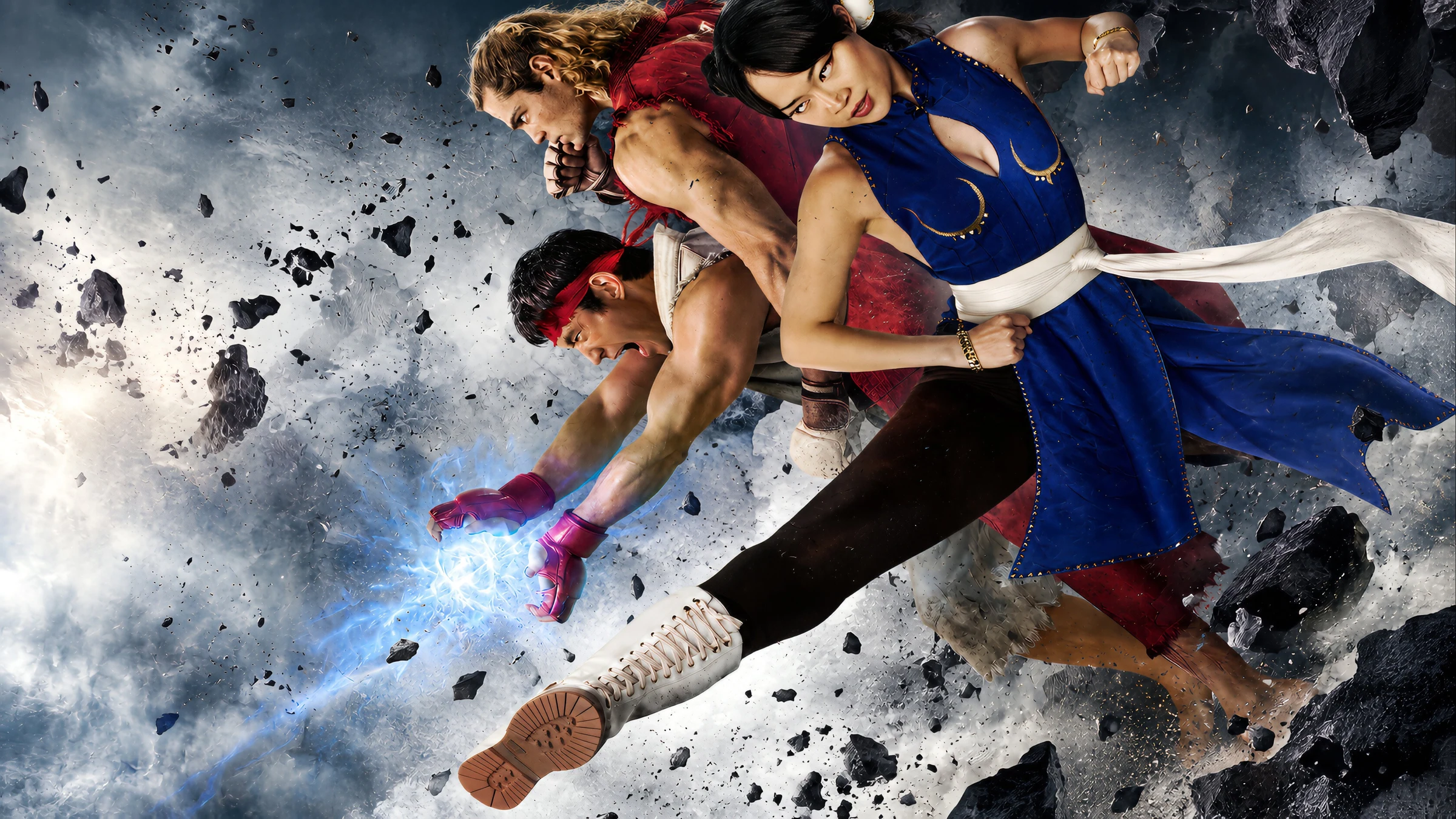
At least half of the mental bombardment comes from onboarding the cast itself. A movie based on a franchise whose appeal, as best I can tell, begins and ends with the CHOOSE YOUR FIGHTER screen had better give us some fucking options in bruisers. It does. And one of Sakurai’s more pleasurable eccentricities is how readily he deploys those bruisers as set pieces.
If you came hoping to see people gruesomely dismembered beneath a neon color palette, you’re going home disappointed. The carnage is cartoonish, not cartoonishly gory. A decision that feels entirely appropriate for a franchise that follows a near-fatal beating with the chipper, suggestive inquiry PLAY AGAIN?
To further tamp down expectations of a film that will deny all of them, Street Fighter likewise isn’t some technical showcase for translating video game physics into live action impossibilities. Sakurai occasionally pulls off that sort of magic trick, but he seems to understand that his budget is best blown in places beyond translating the moves fans of the game could barely see through the pixels to the big screen.
And of course—because he’s clearly fucking with us in half of what transpires—some of the film’s most emotionally effective sequences are animated. Or perhaps they're simply the only scenes in which Sakurai allows an emotion enough time to register.
Objectively, the fourteenth-strangest thing to emerge from this frenzied bacchanal is an actual opportunity for cross-generational reflection. Sakurai flogs his audience with ’90s nostalgia delivered to us in TikTok-sized micro scenes, a format that initially seems at odds with the material. But eventually the two eras begin to rhyme, or the synesthetic equivalent thereof. The arcade games of the ’90s delivered their entertainment in brief, concentrated bursts because the machines were designed to consume quarters. TikTok delivers its entertainment in brief, concentrated bursts because, seemingly, we've become machines designed to consume them. Different logjams, same fun-sized thrill. In all cases, boomers standing ready to pounce on the lot of us for not doing it outside.
Amid all this psychosis, Street Fighter manages something genuinely worthy of applause, particularly in contrast to another recent attempt to wring a movie out of toy aisle nostalgia, the lifeless Matchbox the Movie. Both productions confront source material with only so much prepackaged narrative to work with. Matchbox treated that shortage as permission to assemble a generic action movie and drive the thing straight into theaters.
Sakurai takes the opposite approach. He treats the limited material not as an excuse to do less, but as a dare to do more. He digs into every scrap of folklore he can find, drags an army of oddballs into the ring, and undertakes a deranged effort to convince us they all belong there. He even finds time for some comedic levity. Some of the jokes work, even if many have to be carried out of the arena on a stretcher. But the film’s relationship to its source material at least extends beyond the fucking title card.
The film is not without backstory even if the flow chart of incoming narrative threads would require a whiteboard at home only in the largest university lecture halls. Fighter bros Ken (Noah Centineo) and Ryu (Andrew Koji) have unresolved beef following the demise of their sensei. The operational head of the tournament that is the game, M. Bison (David Dastmalchian), wants to choose as his fighter the darkness that lurks within Ryu. Chaos has indeed erupted in Metro City and it’s bubbling up from its very foundations (the nightclubs). Punches will be thrown before resolution is had.
If the film ultimately buckles under the weight of having too many faceoffs to schedule and insufficient hours in the day to get through them all, it seems to me that it fails into the emotional giddiness it’s supposed to—two little fighter bros stopping off at the arcade after school with only so many minutes allotted by their own tournament organizer, M. Mom, to play their game. If the audience leaves feeling like it was left with less than enough time with the controller to get through all it wanted to explore, Sakurai has masterfully captured the insatiable angst that drove so many quarters into so many cabinets and defined a generation.
That enthusiasm, against all goddamn odds, is the golden-haired, neon goose. Eventually you stop expecting Street Fighter to explain itself and have to live with the fact it’ll continue to be itself. And, as exhausted as it may leave you, you’re still ready to play again.
Thank fuck for that.
← Back to reviews