
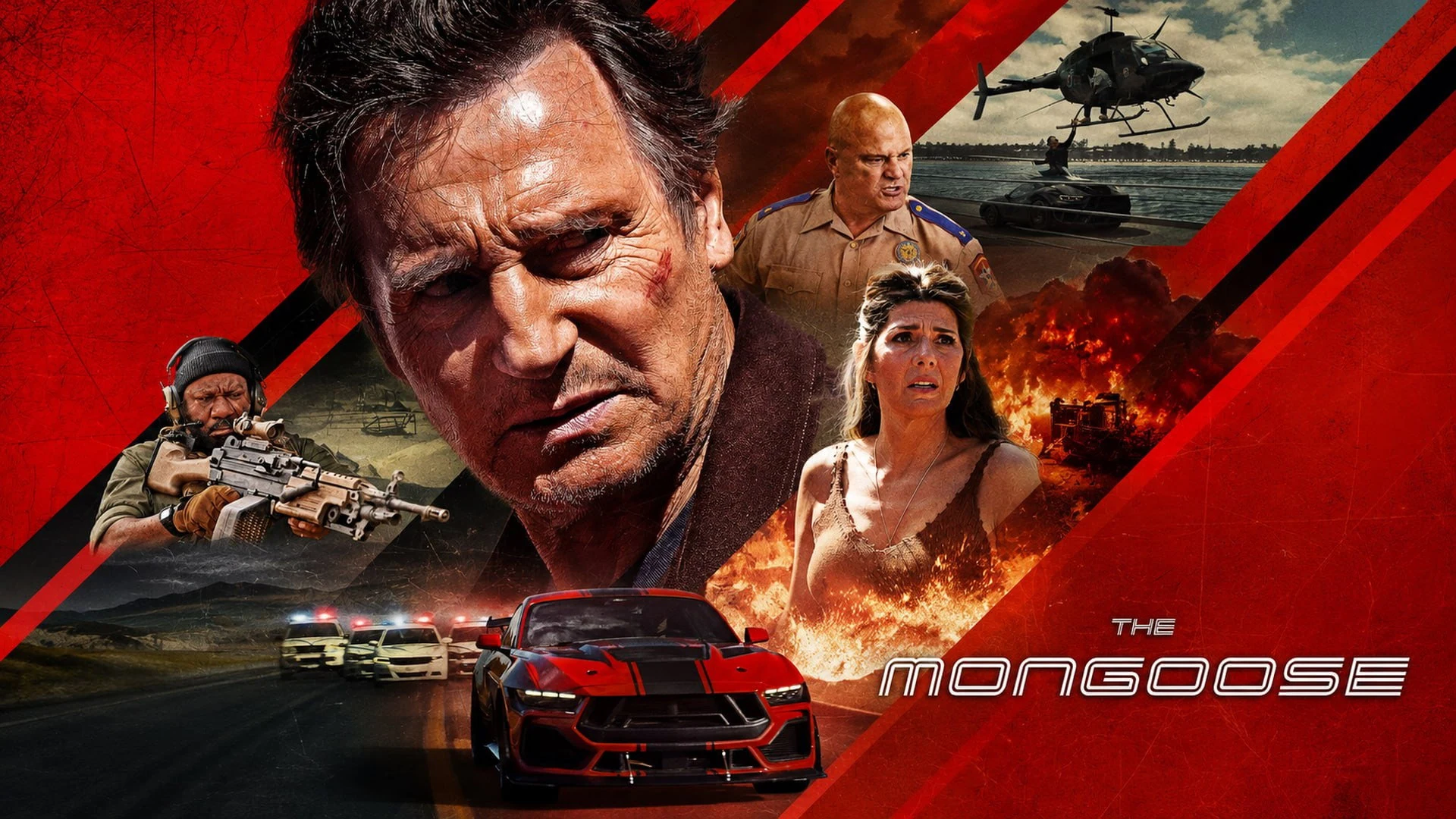
The Mongoose opens with Liam Neeson reading a few lines from Elizabeth Barrett Browning’s How Do I Love Thee? over what appears to be a Windows 98 screensaver of a beach.
After that moving tribute to all the Dells we lost to LimeWire, we’re dumped straight into a car chase.
We don’t yet know who Neeson is or why he’s fleeing, so we’re really only here to evaluate his driving. In that regard, he shifts beautifully when each new gear is spread out over four or five cuts but treats the one-way signs on freeway ramps as suggestions from people with even less of an idea of who he is than the audience. Fortunately, the cops are comically inept at wrangling fleeing cars in the opening scenes of movies, leaving him enough downtime to take a few calls.
Tilton (Maurice Marvel Meredith), the head of the police operation in Arkansas, calls the car phone with some boilerplate pleas to pull over. Neeson, who we now understand to be playing a guy named Fang, hangs up on the police major in favor of a conversation with the car’s digital assistant.
To save us from this godforsaken road trip, we begin repeatedly cutting away to some backstory. First stop is a flashback to Fang’s military past—back when Neeson was still young enough to be only fifteen years too old for active combat—where we see that army buddies Tanker (Ving Rhames) and Munch (Marcus Thomas) were captured with Fang and their age-appropriate comrade Wiz. Wiz didn’t make it back.
Next drive down memory lane is Fang’s divorce from Tara (Marisa Tomei). She expresses the accumulated fury of a failed marriage by kicking an IKEA dresser at about twenty percent power. Neeson responds by shutting a door with even less commitment. I’m happy to report the dresser will be fine. I cannot confirm the door is latched.
The film takes further unproductive trips through the war backstory before we finally reach the flashback explaining why Fang is fleeing in the first place. Tara’s current boyfriend has put her in the hospital. Fang goes to collect her things, encounters Mr. Pending Charges, and kills him.
Nailing this emotional foundation for the entire movie’s existence is pretty outcome determinative for just about any action caper. But when a credible grievance and one well-written threat are enough for Liam Neeson to drag a middling action movie to respectability by its fucking throat, you’d think getting it right would be a priority. Instead, the scene feels like someone scrawled “So there. Motivation.” on a napkin and submitted it as the final draft.
Whatever. The paperwork authorizing another Liam Neeson rampage is finally in order.
In other words, the ’goose is loose.
With the audience now at least vaguely aware of why they should care about this guy fleeing the five-oh, the film’s wheels generally strain to remain fully attached from there. Early on, Tomei spends most of her scenes trying to supply the emotional continuity the screenplay has declined to provide. She brings her trademark ability to evoke tortured compassion on cue to the role. And the script keeps punishing her for it. She’ll land one line with real feeling, then have to swerve into a nonsensical catchphrase before the feeling has left her face, only to have to pile on an additional zinger as if the screenwriter wasn’t fully confident that he’d ruined the moment with the first one. Her initial encounter with law enforcement is especially rough.
Neeson is at least busy driving a car on and off for much of the runtime and can use the excuse to break up the erratic demands of the script. Thankfully, the dialogue settles down as the film heads toward its final act and pares back its ambitions. Good timing, since the screenplay still has to turn an interstate manhunt into a national going-away party.
The film’s attempts to manufacture a national movement around Fang are just as unconvincing. From her CNN desk, Laura Coates emphasizes little more than his war-hero backstory and a photograph in dress uniform until we’re meant to understand that America has collectively decided this man should be allowed to finish his drive to leave the country. The veterans who actually turn up to help him fare better. Or at least have something concrete to say and the courtesy to say it once and then leave.
Pope (Michael Chiklis), the film’s excuse for an antagonist, gives Fang an enemy he can beat so the movie can stop worrying about the problems it can’t resolve. Pope is neither competent enough to be threatening nor funny enough to make his incompetence entertaining. But he’s at least useful in the third act when he’s tasked with bailing The Mongoose out of the need to follow any of its tenuously established emotional routes to a conclusion. By the time the movie needs somewhere to park, Pope has become a PG villain contractually obliged to be outsmarted by Fang and the gang. All that’s missing is a final shot of him throwing his hat on the ground.
That’s where The Mongoose chooses to leave us. All that military trauma, domestic violence, and marital wreckage yield the three former Army men choppering out of the country against the backdrop of a sunset with Tomei cheering from her couch as she watches it unfold on TV.
Apparently this was Free Willy all along. They just made us sit through the whale’s divorce.
← Back to reviews