

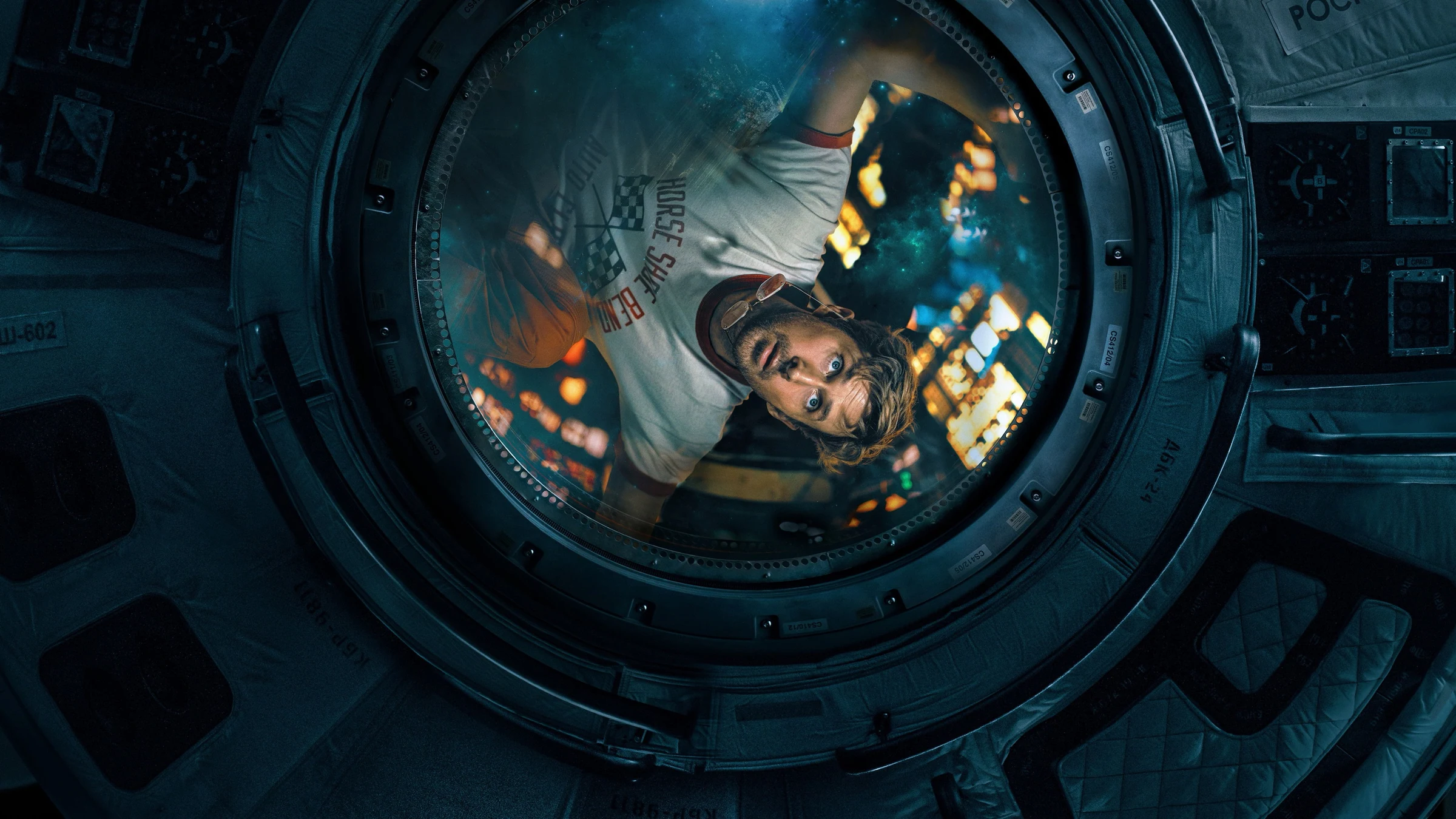
For most of human history, if you wanted to travel into outer space, you had to become an astronaut. Appropriately credentialed spaceflight being so mundane, Hollywood has of course spent decades exploring the opposite proposition.
Oil drillers have been launched into orbit because apparently teaching Texas-based astronauts to use a drill was logistically impossible. Convicts have served their sentences in floating prisons. And even when movie characters willingly venture into space, the real action usually doesn’t begin until they desperately want to leave it. The Martian, Gravity, Apollo 13—pick your preferred flavor of vacuum-induced regret.
But even with all that accumulated formula standing ready to blunt our enjoyment of Project Hail Mary’s formula setup, the entire history of cinematic spaceflight somehow fails to scrub this latest Andy Weir vehicle’s launch.
The film drops us aboard a spacecraft a long way from home and introduces us—mostly via flashbacks—to Ryland Grace, a molecular biologist played by Ryan Gosling with every one of his considerable likability thrusters pinned at maximum burn.
As he recovers from a little amnesia and gets his space legs under him, Grace gradually remembers a mission he once helped design, his flashbacks unraveling the state of things back home and the plan to save the world from a tiny little organism that just happens to wake up and eat the fucking sun for breakfast.
And boy, do we need that light bulb to stay lit.
With the complete destruction of reality TV, the Little League World Series, and life on Earth looming, the planet assembles its best scientists to tackle the problem. Against all odds, they end up outclassed by Grace, a half-brilliant, half-everyman loner whose best attempts to fuck the whole thing up produce an Earth-shattering—and potentially Sun-saving—breakthrough.
That unlikely breakthrough jolts Grace to the top of the international scientist depth chart, giving him a direct line to Eva Stratt, the operational head of the enterprise, played brilliantly by Sandra Hüller. Stratt is both the most ruthless and the most caring person in the movie—the only human being cold-blooded enough to get the project off the ground in time to matter and empathetic enough to understand exactly what that ruthlessness is costing everyone around her. Given Grace’s timid and erratic personality, she spends much of her time getting him to fight for his wins, knowing there is little chance he’ll fight her over who’s in charge.
Back aboard the ship, with his memory finally catching up to his predicament, Grace arrives at the only known star in the near-Earth neighborhood that appears naturally immune to the infestation. His initial plan is plainly to conduct the required science and save Earth by whatever means will allow him to keep his terrified feet planted as firmly as possible on the deck of his spacecraft.
Almost immediately, another ship arrives and scares Grace back into his ship’s deepest cavities to hide in his NASA-issued onesie, and the whole mission seems like more than he can handle.
Thankfully for the human race, though, the new ship belongs to the galaxy’s most aggressively friendly pet rock.
From there, Project Hail Mary settles into what may be the most heartwarming intergalactic buddy movie ever made.
While it might surprise no one that Gosling has the chops to carry the movie through to the end, the film’s middle act showcases another impressive gear in the actor’s engine as so much of the runtime is dedicated to scenes where Gosling is the only human on the screen. He must sell fear, scientific exhilaration, frustration, loneliness, and eventually genuine affection with only a puppet to support his performance.
He absolutely pulls it off and single-handedly anchors one hell of a movie.
But holding the screen without another human actor is only the first feat. The harder one is making us care what happens to his unlikely co-star every bit as much as what happens to Earth.
Gosling makes Grace’s affection for his fellow explorer—yeah, we’re still talking about a rock—feel so completely genuine that what might otherwise have been the movie’s goofiest conceit becomes its greatest emotional asset. Somewhere underneath all the orbital mechanics and end-of-the-world biology, Project Hail Mary quietly updates its mission parameters. Saving humanity remains the plot. But Grace’s connection with Rocky gradually becomes the point. And, gorgeously, the movie unfolds into an unexpectedly persuasive case that community and kinship might extend a little farther than the boundaries of our own species.
Weir, too, deserves credit for resisting the gravitational pull of the perfectly circular Hollywood ending. That choice will probably still frustrate viewers who want every spacecraft—and every character arc—to return neatly to its point of origin.
I didn’t.
By the time the credits roll, Project Hail Mary has earned something more interesting than a trip home.
← Back to reviews